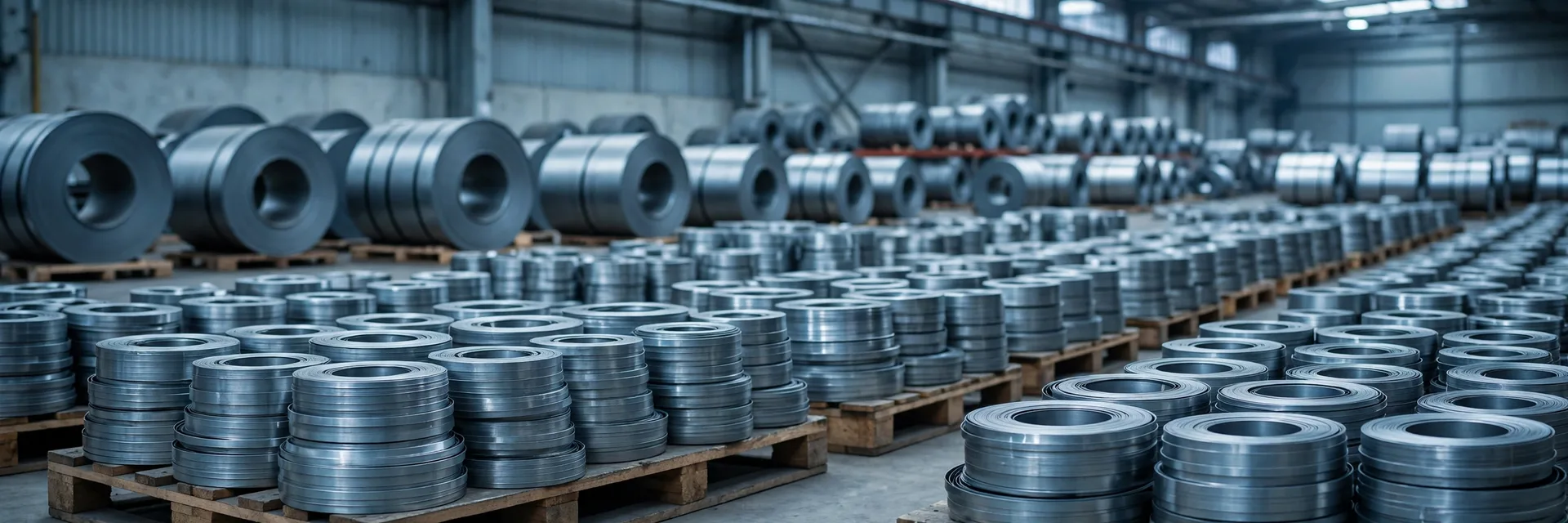
Bearing steel strip is cold-rolled strip for stamped bearing rings, drawn needle cups and thin-section thrust washers that cannot be economically turned from solid material. GCr15, S45C and SUS440C are the candidate grades, with grade chemistry, cleanliness, carbide condition and heat treatment to be agreed, and final feasibility subject to technical review.
GCr15 (SUJ2 / AISI 52100) · S45C · SUS440C — Cold Rolled for Bearing Components
Bearing components can be exposed to concentrated contact stress and demanding dimensional requirements. Grade chemistry alone does not establish suitability: cleanliness, carbide condition, decarburization, heat treatment, geometry and finished-component testing may also govern.
Cold-rolled strip provides a manufacturing path distinct from bar/tube stock: it enables stamped bearing rings, drawn needle cups, and thin-section thrust washers that cannot be economically turned from solid material. The strip route also reduces machining — stamped and formed parts are near-net-shape, requiring only grinding after heat treatment.
| Grade | Comparable designations | Hardness reference | Typical candidate uses | Selection note |
|---|---|---|---|---|
| GCr15 | SUJ2 (JIS) / 52100 (AISI) / 100Cr6 (EN) | Hardness to be agreed | Bearing rings, needle rollers, thrust washers | 1.0% C + 1.5% Cr. A commonly referenced grade for rolling-bearing components. |
| S45C | 1045 (AISI) / C45 (EN) | Hardness to be agreed | Bearing cages, retainers, low-load races | Medium carbon. Tough core with hard surface after induction hardening. Lower cost for non-critical bearings. |
| SUS440C | 440C (AISI) / X105CrMo17 (EN) | Hardness to be agreed | Corrosion-resistant bearings, food/marine | 17% Cr stainless + 1.0% C. Maintains hardness while providing corrosion resistance. Validate corrosion resistance in the actual service environment. |
For bearing-grade strip ordered in a spheroidized condition, buyers should define the carbide assessment method, rating limit, sampling frequency and applicable standard. A percentage should not be assumed without an agreed inspection basis.
| Parameter | Range | Notes |
|---|---|---|
| Thickness | Confirm grade-specific availability | State thickness, width, tolerances and measurement method |
| Width | Confirm slit-width feasibility | Custom slit to ring blank width |
| Surface Finish | Specify finish and roughness test | Critical for raceway surfaces formed directly from strip |
| Flatness | Specify limit and measurement method | Validate flatness and springback in the intended stamping process |
| Delivery Condition | State the required condition | Define metallographic inspection and acceptance criteria where needed |
| Edge | Slit / Deburred | Deburred edges available for direct-feed to progressive dies |
Inner and outer races for drawn-cup needle bearings (automotive gearbox, rocker arms). Stamped from GCr15 strip, through-hardened to Hardness to be agreed, then precision ground.
Flat thrust bearing components stamped from 0.5-2.0mm strip. GCr15 for standard applications, SUS440C for hydraulic systems with fluid exposure.
Retainer cages stamped from S45C or GCr15 strip. Require excellent formability in annealed state, then surface hardening for wear resistance against rollers.
Guide rails, slider beds, and flat bearing surfaces for linear guides. GCr15 strip ground to mirror finish after hardening for low-friction sliding contact.
Bearing steel may require controls beyond a general cold-rolled strip order. State which of the following tests and documents are required:
Saw Blade Steel Strip · Spring Steel Strip · Automotive Stamping Steel Strip · Knife Blade Steel Strip
The page covers GCr15 (SUJ2 / 52100 / 100Cr6) for bearing rings, needle rollers and thrust washers, S45C (1045 / C45) for bearing cages, retainers and low-load races, and SUS440C (440C / X105CrMo17) for corrosion-resistant bearings.
The page states that grade chemistry alone does not establish suitability: cleanliness, carbide condition, decarburization, heat treatment, geometry and finished-component testing may also govern the application.
State inclusion rating per ASTM E45 or ISO 4967, with oxide type no more than 1.5 and sulfide type no more than 1.0, carbide network rating, decarburization limit of 1.0% of thickness per side, surface inspection, chemical composition, certificate type and heat-number traceability.
State thickness, width, tolerances and measurement method, slit-width feasibility, surface finish and roughness test, flatness limit and measurement method, delivery condition and slit or deburred edge. Final dimensions and feasibility are confirmed against the order specification, subject to technical review.